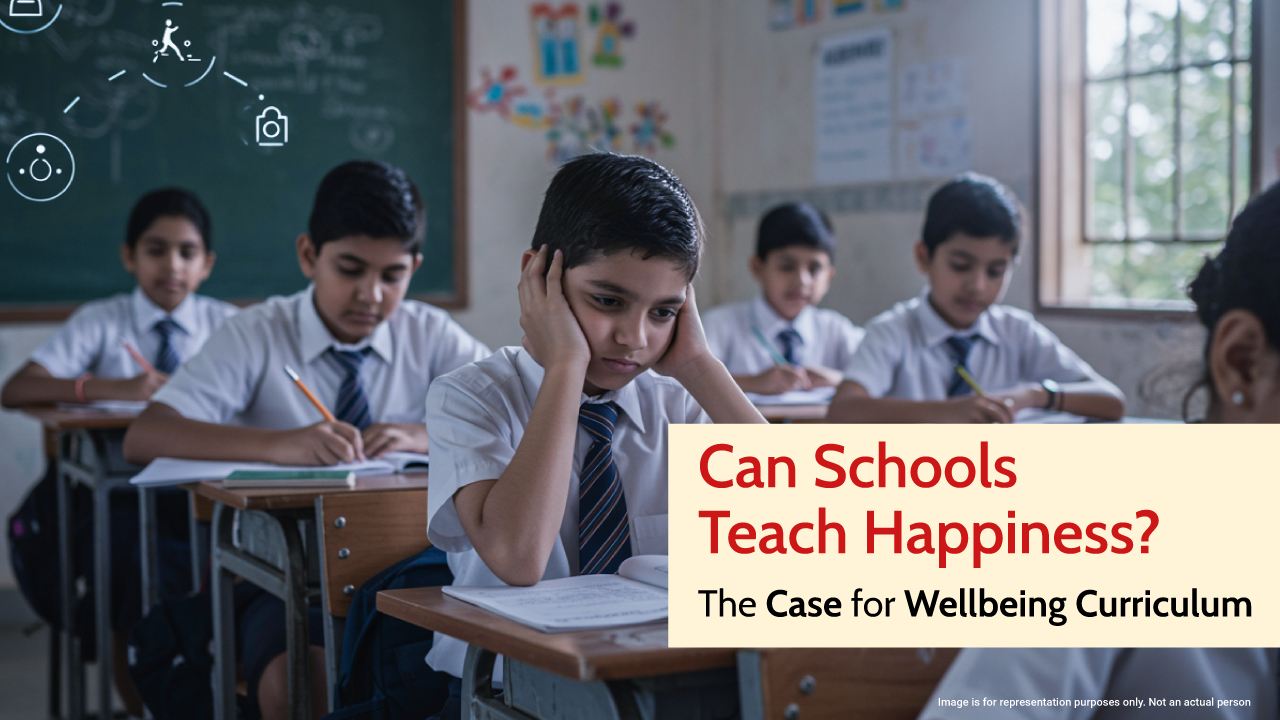
The morning bell rings. Children file into classrooms with heavy bags and heavier expectations. Marks, rankings, performance. These define success for most of them. Yet behind the routine of lessons and homework, something quieter often goes unnoticed. A child who feels anxious before speaking. Another who struggles to fit in. One more who appears cheerful but carries silent stress. Schools teach many things well, but the question remains. Are they teaching children how to be well?
Happiness in education is often misunderstood. It does not mean that there should be nothing but pleasure and no trouble. It has to do with giving youth the power to know themselves, regulate their emotions, develop healthy relationships, and overcome uncertainty. These skills are no longer a luxury in a fast-changing world. They are foundational.
Beyond Marks & Metrics
Measurable outcomes in education systems have been the center of interest for decades. The main measures of success are scores, grades, and achievements. Although these are essential, they are just a fraction of a child's development.
A student can perform well academically and still feel overwhelmed, isolated, or not good about themselves. Another can have difficulty in exams, but can be a strong-willed, understanding, and creative person. These dimensions are not always considered under traditional systems, as they are more difficult to quantify.
A wellbeing curriculum shifts this perspective. It asks a different set of questions. How does a child feel about themselves? Can they cope with failure? Do they know how to ask for help? These are not soft concerns. They are life skills that shape long-term outcomes far beyond the classroom.
What Does a Wellbeing Curriculum Look Like
A wellbeing curriculum is not a separate subject added to an already crowded timetable. It is an integrated approach that becomes part of everyday learning.
It includes practices that help children become aware of their thoughts and emotions. Simple reflection exercises can teach them to pause and understand what they are feeling. Classroom conversations can create safe spaces where students learn to express themselves without fear of judgment.
Social and emotional learning is important. Empathy, teamwork, and communication activities help children connect better with others. The resolution of conflict becomes an opportunity to learn and not a penalty. Errors are perceived as a chance to develop.
Teaching coping skills is also significant. It could be exam pressure, peer pressure, or personal issues, but children must have something that enables them to respond with clarity rather than react under pressure.
When properly integrated, these practices do not occupy time that would otherwise be spent on academic learning. They enhance it. A safe, confident, and emotionally balanced child is more inclined to engage, participate, and perform.
The Ripple Effect on Classrooms & Communities
The impact of wellbeing education extends beyond individual students. It transforms the entire school ecosystem.
Classrooms become more inclusive and collaborative. Teachers shift from being only instructors to facilitators of growth. Discipline moves from control to understanding. Over time, this creates a culture where respect and trust replace fear and pressure.
Families and communities are also affected by the benefits. These skills are taken home by children. They become more effective in communication, emotion management, and influencing the environment around them. Minor shifts start forming larger shifts.
These skills may be particularly effective in societies where stress, uncertainty, or resource scarcity is a given. They help youth develop a sense of strength in spite of harsh external circumstances.
Why This Matters Now
Today's learners are growing up in a complex world. They are exposed to constant information, rising expectations, and evolving social dynamics. Academic knowledge alone cannot prepare them for this reality.
There is also a growing recognition that mental health challenges are affecting younger populations. Ignoring this does not make it disappear. It only deepens the gap between what children experience and what schools address.
A wellbeing curriculum bridges this gap. It acknowledges that education is not only about preparing students for exams but for life itself. It redefines success to include not just achievement, but also balance, purpose, and resilience.
The Role of SivaShiksha
At this point, deliberate interventions are essential. SivaShiksha operates at the nexus of education, culture, and wellbeing to transform the way learning environments are created.
We follow the philosophy based on the notion that each child has potential that transcends academic capability. Using experiential programs, creative practices, and community involvement, it presents wellbeing as an experience rather than an idea.
The workshops and training are designed to develop emotional awareness, confidence, and self-expression. Teachers are supported to build not only classrooms but also nurturing classrooms. Communities are engaged to take learning outside the school.
By combining cultural wisdom with modern practices, SivaShiksha establishes environments where children feel recognized, listened to, and appreciated. This way, it does not simply bring wellbeing to education. It transforms education itself into a more human, inclusive, and empowering experience.