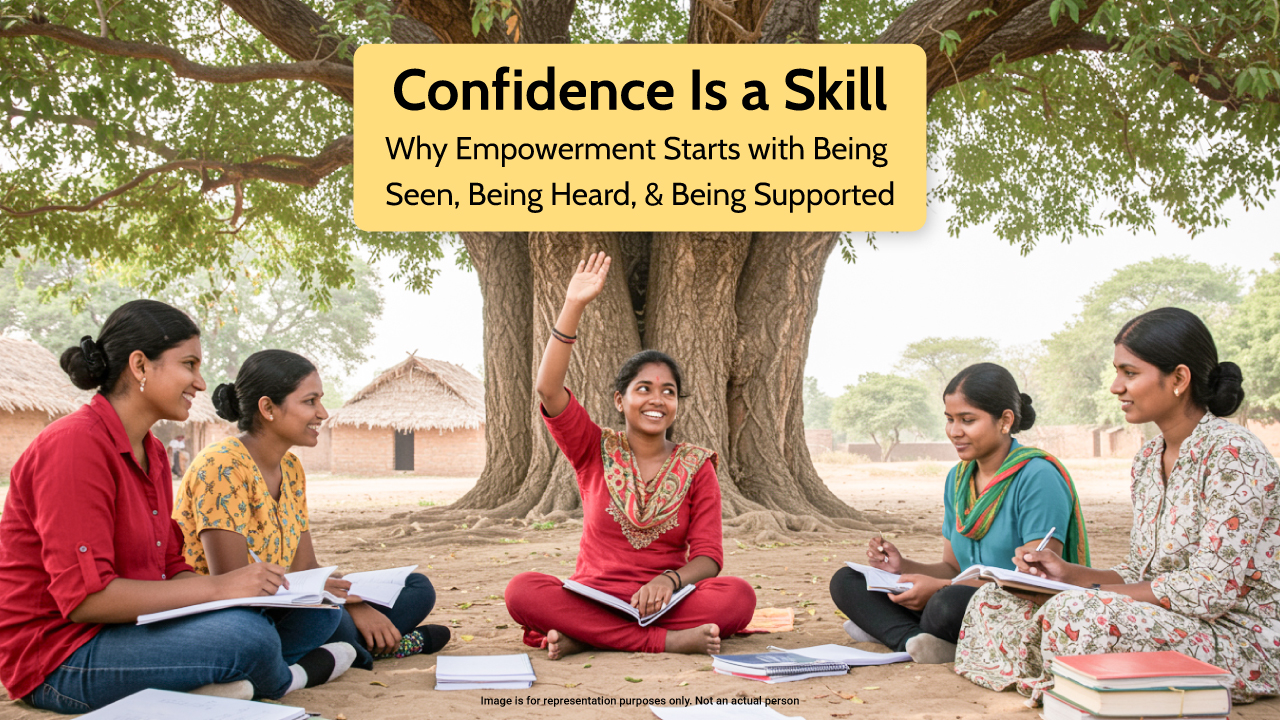
Ishita always sat in the second row of her classroom, which was close enough to hear clearly and far enough to disappear.
She often knew the answers before anyone else, but her hand remained down. This was not due to uncertainty, but to lessons absorbed over time. She had learned, quietly and carefully, that seeking attention could carry consequences. A wrong answer brought ridicule; even a right answer could lead to questions she wasn't ready to face.
With time, it became safe to remain silent.
Ishita’s story is not unusual. It rings in schools, training centers, and community halls across the country. While we frequently talk about barriers to education, resources, or opportunities, we rarely discuss confidence, the invisible skill that determines whether opportunities are ever truly seized.
Why Confidence Is Not Just Personality
Confidence is usually confused with the fact that you are either confident or not. We name children at a young age, she is shy, he is bold, and we accept this as their permanent personality traits. However, confidence is not personality. It is an environmental reaction.
Confidence comes about when learners are motivated to ask questions, make mistakes, and are treated as competent thinkers. It becomes smaller when they are reprimanded in front of an audience, fired, or neglected repeatedly.
The confidence does not go away quickly. It is worn away at a slow rate- whenever a voice is interrupted, whenever curiosity is swept away, whenever industry is not appreciated, and perfection is esteemed.
The Cost of Low Confidence in Education & Beyond
Low confidence can hardly appear dramatic because it looks like hesitation, or self-doubt, or playing it safe.
It shows up when, despite having the skills, a girl does not want to take leadership positions. A student learns by heart rather than doubting.
The younger generation is reluctant to study technology, assuming it is not something someone like me should know. An effective person will wait until they are not given a green light. This is internalized with time. Individuals cease to regard themselves as enactors and begin to regard themselves as spectators of their existence.
That is the way inequality perpetuates itself, not necessarily by depriving one of opportunity, but by depriving one of faith.
How Observing and Listening Build Confidence
Confidence starts when one feels perceived not as a number, a rank, or a background, but as a thinking, capable individual.
When one of the learners' questions is given serious consideration! When their experience of life is recognized as legitimate knowledge! When learning is participatory and not a performance! Being perceived reminds an individual that they belong!
Anything becomes stronger when it is heard by someone. Listening is one thing, but being allowed to speak is another thing. There are numerous places where one can talk and be rewarded with conformity. One can develop true confidence in an environment where different views are not judged, disagreement is not a crime, and expression is not a rebellion.
By making learners share ideas, reflect, and even speak without fear of being mocked, they begin to believe in their own thoughts.
And confidence is based on trust!
The Power of Supportive Environments
One inspirational speech or seminar is not enough to build confidence. It grows with constant encouragement.
Support means creating safe spaces where learners can try and fail, having mentors who listen rather than just lecture, and fostering learning environments that adapt to individual needs. Above all, it is a reminder that growth matters more than speed.
Confidence is long-lasting with support. It does not fade away with the initial failure.
SivaShiksha’s Impact: Turning Confidence Into Capability
That is where SivaShiksha makes a significant appearance.
SivaShiksha never considers confidence a product of magic, but rather a result of education. It is an approach that views confidence as a competency to be developed. By using community-based learning, inclusive classrooms, and emotionally safe learning environments, SivaShiksha not only educates learners but also empowers them.
Through the combination of expression, dialogue, and emotional perception within its learning facilities, SivaShiksha helps people find their voice and raise it. Girls who were hesitant start talking. Students who lack confidence in themselves start attempting. Societies start to change not because someone told them they should be confident, but because they were now listened to, heard, and helped.
After all, confidence does not mean to be louder.It is about thinking it through to the bottom of your heart and realizing that your voice is important.