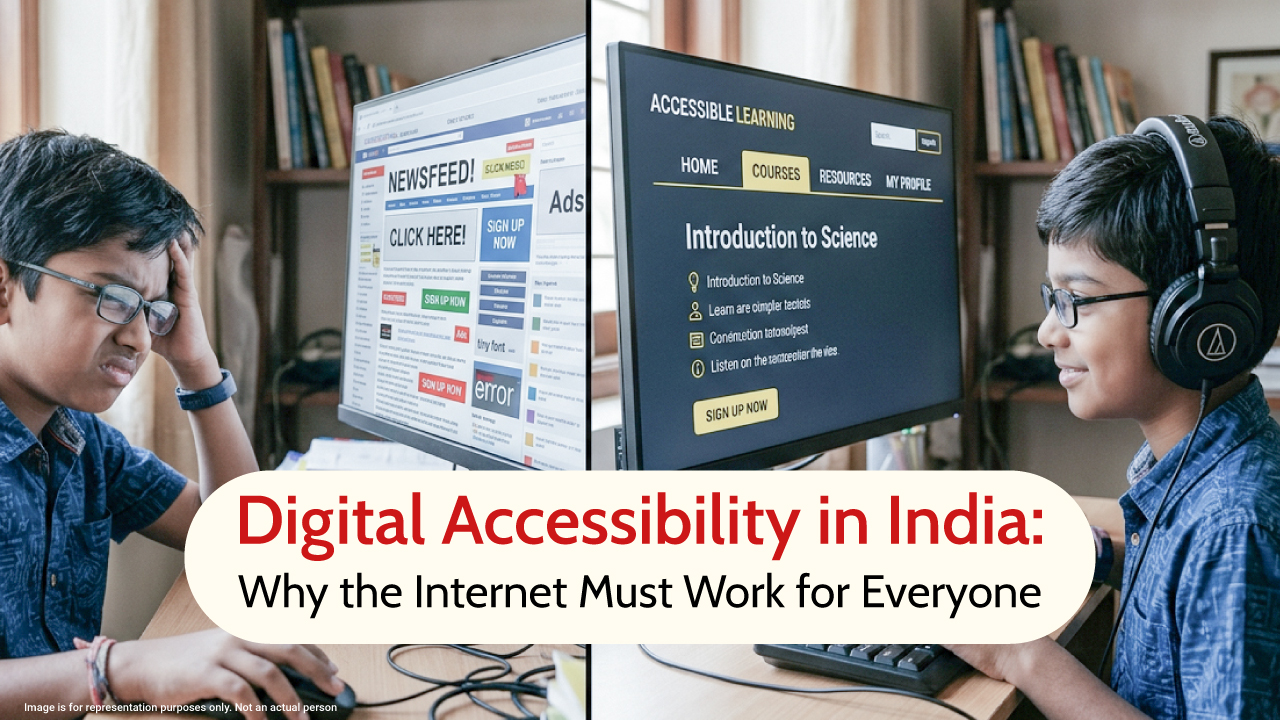
The internet has become one of the most powerful tools of our time. It connects people across distances, opens doors to education and employment, and creates spaces where ideas can be shared and voices can be heard. For millions, it is a gateway to opportunity.
Yet, for many people with disabilities, this gateway is not fully open.
Imagine trying to fill out an online form where buttons cannot be read by a screen reader. Or watching an educational video without captions. Consider navigating a website where the text cannot be enlarged, the colors blend together, or every action depends on precise mouse movement.
For people with disabilities, these are not occasional challenges, they are everyday realities.
Digital Growth in India & the Accessibility Gap
India is rapidly embracing digital transformation. From education and banking to healthcare and government services, the internet is becoming central to daily life.
However, many digital platforms are still designed with a narrow assumption of the user, someone who can see clearly, hear easily, and navigate complex interfaces without difficulty.
This assumption unintentionally excludes millions of individuals from accessing essential services and opportunities.
Digital accessibility ensures that online spaces are designed for everyone, regardless of their physical, sensory, or cognitive abilities. It is not just about usability, it is about equality and inclusion.
Understanding Accessibility Across Different Needs
Accessibility looks different for different individuals, but the goal remains the same: independence and ease of use.
For people with visual impairments, accessibility depends on compatibility with screen readers that convert text into speech or Braille. When websites are properly designed, these tools allow users to navigate and engage with content independently.
For individuals with hearing impairments, captions, transcripts, and visual alternatives are essential. Without them, videos, announcements, and learning materials become inaccessible.
People with physical disabilities may rely on keyboards, voice commands, or assistive technologies instead of a mouse. Without accessible design, even simple actions like filling forms or browsing pages can become difficult.
Individuals with cognitive or learning disabilities benefit from clear layouts, simple language, and predictable navigation. Overly complex designs can create confusion and reduce accessibility.
In every case, the barrier is not the individual, it is the way technology is designed.
Simple Solutions for Digital Accessibility
The encouraging reality is that many accessibility improvements are simple and cost-effective.
Adding alternative text to images, ensuring proper color contrast, including captions in videos, and enabling keyboard-friendly navigation can significantly improve accessibility.
These changes may seem small, but they create meaningful impact by making digital spaces usable for millions of people.
Accessibility benefits everyone. Captions help people in noisy environments. Clear layouts improve readability for all users. Voice navigation supports multitasking.
Inclusive design is not a limitation, it is an enhancement.
The Need for Inclusive Design in India’s Digital Future
As India continues to expand its digital ecosystem, accessibility must be an integral part of design, not an afterthought.
Inclusive design ensures that progress does not leave anyone behind. It reinforces the idea that participation in the digital world is not a privilege, but a right.
When people with disabilities have independent access to information, opportunities, and communication, technology becomes a tool of empowerment.
Achieving this requires awareness, collaboration, and commitment from developers, educators, organizations, and communities.
SivaShiksha’s Mission to Advance Digital Accessibility
SivaShiksha is committed to promoting inclusive learning and digital literacy by helping communities understand the importance of accessibility.
Through awareness programs, educational outreach, and community engagement, the organization encourages equal access to technology for people of all abilities.
Its approach focuses on building digital environments that are flexible, inclusive, and empowering.
By supporting communities and fostering understanding, SivaShiksha contributes to a future where digital spaces act as bridges, connecting people, ideas, and opportunities without barriers.