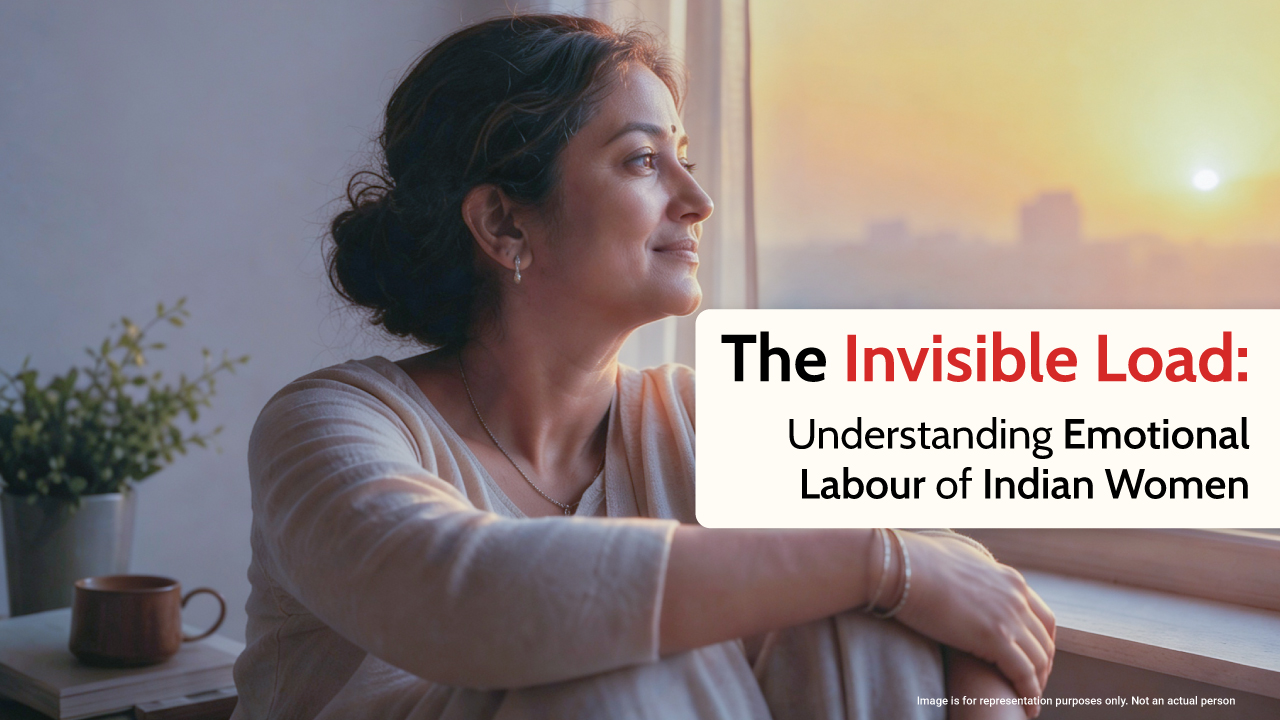
Morning is frequently early on this day. Plans are made, conversations are recalled, and duties are anticipated before others point them out. A child's mood, an elder's prescription, a partner's anxiety, a family squabble that needs to be worked out. All day long, many emotional adaptations occur spontaneously and silently.
Professionalism is shown at work, even when things are tough. Patience is still maintained at home, even when tired. The norms of care, warmth, and emotional availability are universal in social settings. Much of this work is not visible to the naked eye. However, it informs houses, relationships, workplaces, and communities every day.
Emotional labour is an unseen work of emotion.
Emotional labour is the management of emotions, both for yourself and for others, to maintain harmony, care, and stability. Everyone has to do it to some degree, but Indian women tend to bear a heavier burden of responsibility in their personal, professional, and social worlds.
This type of labour is exhausting, but the challenge is that it is not recognized as labour, in the first place.
Care Work That Is Expected, Not Acknowledged
Many women are trained from an early age to be emotional supports for others. They should be able to accept, adjust, be patient, and remain emotionally available at all times, regardless of their own feelings.
This expectation is normalized over time. There's a hidden schedule for dealing with family tensions, keeping track of emotional details, providing comfort, meeting one's own needs, and maintaining relationships.
The actions are linked to care and femininity and are thus often perceived as natural duties that do not demand energy or emotional resources. What happens is that many women still silently carry these invisible loads, even when they feel burdened.
The emotional burden is particularly heavy since it never stops. Emotional labour is ongoing and perpetual, unlike tasks that can be done and checked off. It is present in anticipation, observation, and continual emotional control.
The Weight of Balancing Multiple Roles
Today, women in India have to take on more roles than ever before. Many are juggling work, childcare, income, and social expectations.
But as women enter into leadership, entrepreneurship, work environments, and other fields, the same expectations for them as for men seem to persist. Emotional burdens don't necessarily decrease when you're successful in another aspect.
A working professional could end a long day at work, then get home and be responsible for the family's emotional needs. Even though a young woman's goal is to pursue education, she may still feel pressured to prioritize family needs over her own welfare. Emotional labour teaches many women to put themselves last, no matter what.
This imbalance can cause fatigue, anxiety, emotional burnout, and invisibility over time. By taking care of others, many women become so accustomed to putting others' needs before their own that they forget to take care of themselves.
Why Emotional Labour Remains Invisible
Emotional labour is challenging to address because it is embedded in cultural and social structures. It's usually communicated in subtle, seemingly insignificant actions.
Keeping birthdays in mind, managing family dynamics, monitoring someone's feelings, adjusting tone when things are challenging, and maintaining the peace during disagreements. Taken one at a time, these moments might be trivial, but taken together, they require constant emotional tending.
Self-sacrifice is often rewarded in society, but the long-term emotional health consequences are not always considered. How much discomfort a woman can endure in silence is often treated as the measure of her strength.
Because of this invisibility, building support systems becomes even harder. Without recognition of labour, structures of support are rarely developed around it. Women can find it difficult to talk about emotional fatigue for fear of being seen as ungrateful, weak, or incapable.
Moving Toward Shared Emotional Responsibility
Recognizing emotional labour is not about minimizing care, empathy, and connection in families and communities. It is about understanding that emotional health should not be the sole responsibility of one person.
Awareness is the first step. Conversations around emotional labour help make invisible patterns visible. They give women a voice to express experiences that are often silenced or normalized.
Emotional responsibility must be more equally shared in homes, workplaces, and communities. Care work, emotional care, and relationship management cannot be seen merely as a given of gender.
Workplaces also play a part in fostering environments where emotional wellbeing is valued alongside productivity. From early on, young people can be helped to develop healthy understandings of emotional expression, boundaries, and shared responsibility in educational settings.
But most of all, women deserve spaces where they can feel supported, heard, and free from the pressure to perform strength continuously.
The Importance of SivaShiksha
The philosophy of SivaShiksha is people-centric and treats emotional wellbeing as an integral part of social development. Its programs provide opportunities for women and communities to discuss issues of emotional health, identity, and self-worth in an open and inclusive environment.
SivaShiksha aims to promote awareness and visibility of emotional labour as a form of labour, not weakness, but a necessary reality that must be supported. Through workshops, wellbeing programs, creative expression, and community engagement, it brings these conversations into the open.
We also have a strong interest in developing confidence, emotional resilience, and collective awareness to enable empowerment that goes beyond access to deeper personal change. SivaShiksha fosters conversation, contemplation, and active engagement to build spaces where women may feel seen beyond what they do for others.
In doing this, we help enable a future in which care is valued, emotional wellbeing is placed at the heart of development, and responsibility for emotional support is more equally shared across society.