A chair remains empty at the dining table. A familiar voice no longer answers when called. A phone number stays saved long after there is no one on the other end. Life continues moving forward, yet something feels permanently altered.
Loss arrives in many forms. It may come through the death of a loved one, the end of a relationship, the loss of health, a migration that separates families, or a dream that never unfolds as imagined. Regardless of its form, grief has a way of reshaping the landscape of everyday life.
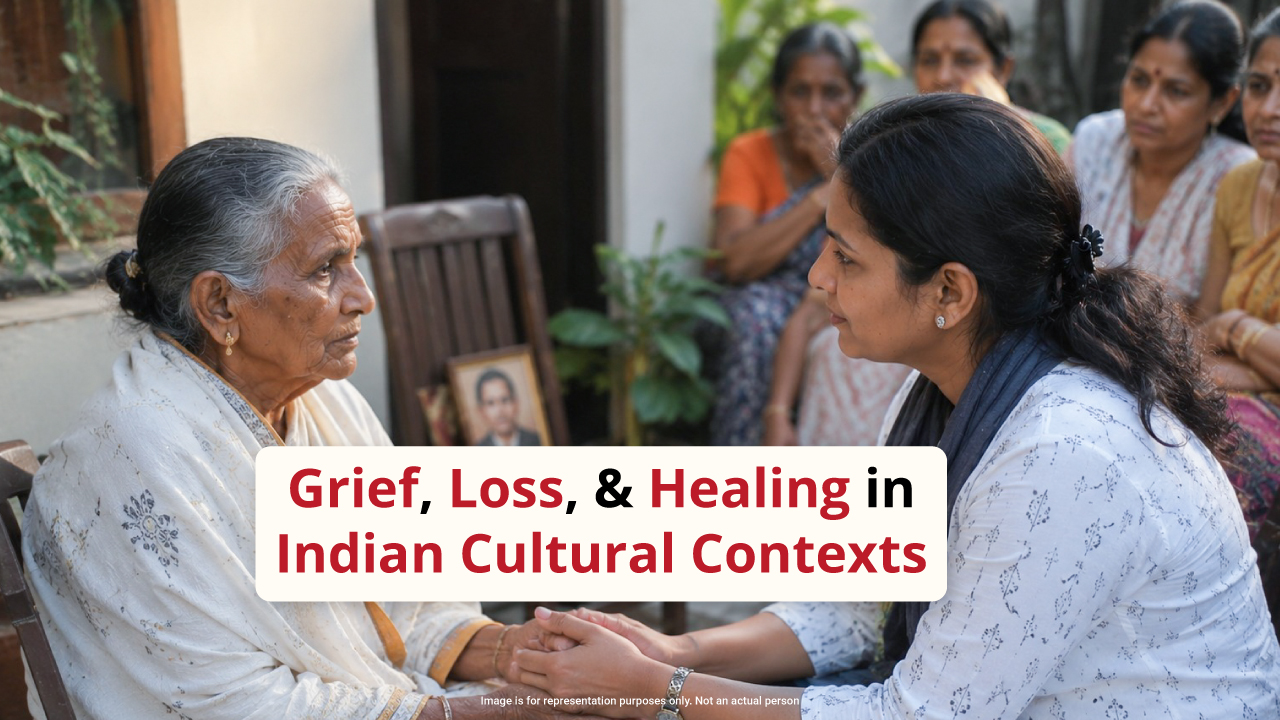
Yet grief is not only a personal experience. It is also deeply influenced by culture, community, and the stories people inherit about loss and healing. In India, where relationships often extend beyond individuals to families, traditions, and collective identities, grief carries layers of meaning that are both deeply personal and profoundly communal.
Understanding grief in this cultural context helps us move beyond the idea of simply "getting over" loss. Instead, it invites us to explore what it means to live with loss, honor it, and gradually heal through it.
When Loss Touches More Than One Life
Relationships are intricately connected in many Indian households. Families are often multigenerational and linked in many ways, through responsibilities, memories, and emotional connections.
Loss is seldom a one-person experience. It affects whole families. Daily routines change. Traditions feel different. Celebrations might indicate a lack that can't be overlooked.
The grief of a community can be comforting and challenging. Family and community support can be a strength at times of difficulty, on the one hand. The other way, people can feel pressured to be strong for others, putting their feelings aside.
There are people out there who deal with both their private grief and public expectations. They take on the role of caretaker, organizer, or emotional support system without telling others, and they carry their own burden of suffering.
In such cases, grief may also be felt as guilt.
The Stories We Are Told About Grief
Cultural beliefs strongly influence how people feel about loss. In the various traditions of India, there are rituals and ceremonies, prayers and communal events that accompany the process of grief and help to validate and support what has been lost.
These practices have a significant emotional purpose. They establish order in times of crisis. They provide for recall. They let her know that she is not alone in her grief.
Meanwhile, people's stories and narratives can sometimes establish unspoken expectations of grief. Some may feel the need to hasten the move to forget. Some may go through a period when expressing intense emotions is not okay for them.
The truth is that grief doesn't have a set schedule.
One person can openly express emotions. Another may experience loss silently. Others have "reminiscing" episodes of sadness months or years after that. Others experience grief as fatigue, irritability, anxiety, or emotional numbness.
When people feel that they have to grieve in socially acceptable ways instead of socially appropriate ways, healing is more challenging.
The Grief We Often Do Not Recognize
Often, people equate grief with bereavement. Many kinds of grief are not visible, though they do not receive public recognition.
A young person who has left home and feels disconnected and lost. A parent who is mourning their child's potential. An individual who may be losing identity due to illness, retirement, or life changes. The separation of families because of migration and distance.
These experiences do not necessarily contain death, but can be very emotionally painful.
Many people are experiencing a grief that has no ritual, ceremony, or formal place to be felt and expressed in a rapidly changing society. This means these feelings can go unexpressed and be misinterpreted.
It's crucial to acknowledge that these experiences can also trigger feelings of "normal grief" responses and support healing.
Healing as Connection, Not Closure
Perhaps the most common misconception about grief is that healing means forgetting, moving on, or going back to how we were.
Grief alters people, though. Healing isn't about forgetting that change. It is learning to bear the burden and live life.
Healing comes in connection for many. Talking with trusted individuals. Acts of remembrance. Creative expression. Spiritual practices. Community support. Space for reflection where emotions are not avoided.
Collective support can have a special significance in Indian culture. Often, during challenging times, people feel held by shared rituals, storytelling, music, art, and community gatherings.
Often, healing will not occur in isolation. It is developed through relationship, understanding, and permission to experience grief without judgment.
The Role of SivaShiksha
SivaShiksha appreciates the importance of emotional wellbeing as a critical piece to human development and community resilience. Its work provides safe and compassionate environments for people to explore experiences of loss, transition, and healing through meaningful conversation and connection to community.
SivaShiksha fosters emotional awareness and resilience through initiatives focused on wellbeing, creative expression, experiential learning, and community engagement, all of which respect the cultural contexts that shape personal experiences. Its process is based on the principle that healing is not only an individual experience but also a communal one.
SivaShiksha creates opportunities for people and communities to grow emotionally, with respect and openness. It does so not only by offering a future without silence, but also one filled with compassion, connection, and healing support.