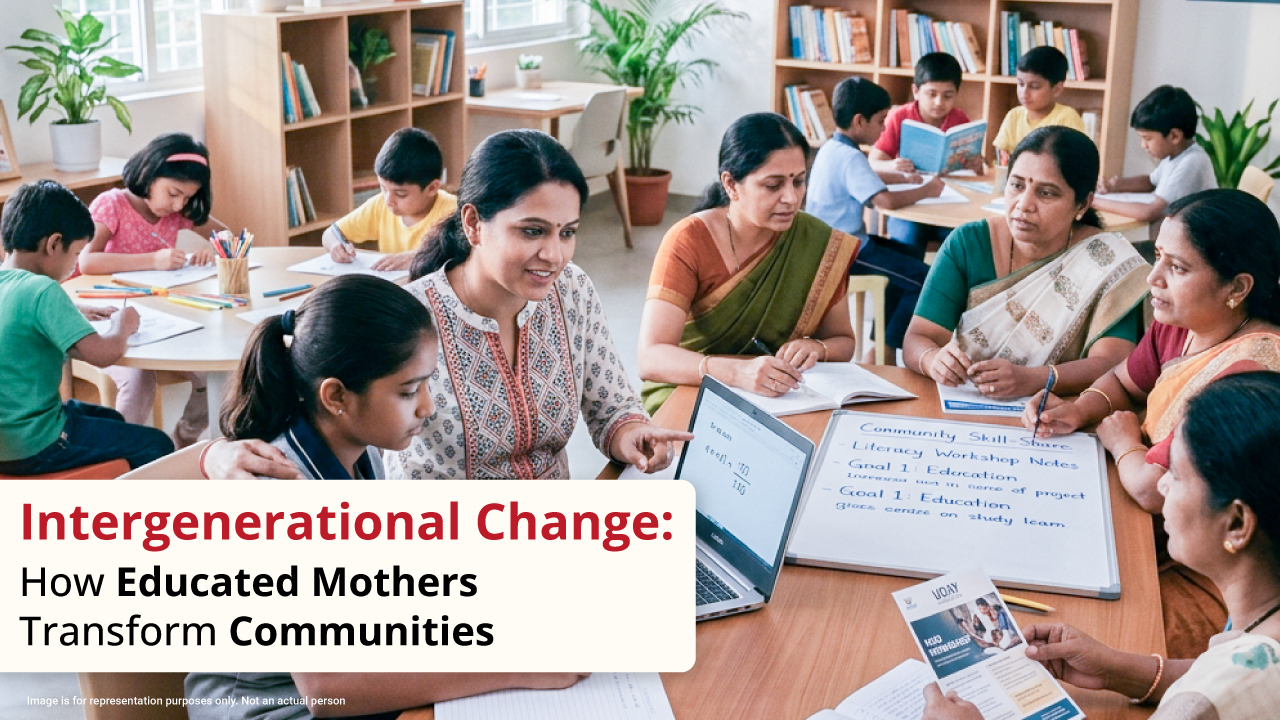
A mother and her child are sitting by the window late in the evening in a small house on the outskirts of a busy neighborhood, where the mom is helping her child with homework after a long day at work. Though she might not have had the same opportunities a child growing up had, she will not accept any choice for her child's life other than education. Another family, a woman with a clear voice, participates in a community meeting, asks questions, and urges other families to share their opinions.
They can be normal moments that are the start of a much bigger event. Whether it's from one generation to the next or from one community to another, educated mothers are slowly creating new social realities that will endure beyond their lifetimes.
Education has a transformative power; it is not just transforming individuals. When in the hands of female leaders, particularly mothers, it can be a power that transforms families and entire communities.
When One Woman Learns, Many Lives Shift
Education, and specifically women's participation in education, has a strong connection to and influence on the wellbeing of the next generation. A pre-educated mother is more likely to focus on health care, continue her schooling, build confidence, and build learning environments.
It is in these places that children are educated as if it were a natural thing rather than a duty they have to fulfill. Curiosity is encouraged. Questions are welcome. Aspirations feel possible.
This impact extends beyond the academic realm. An educated mother is likely to foster communication, emotional sensitivity, and decision-making in the family. They don't just become advocates for their children's futures; they also become healthier, more informed communities.
Education also changes women's perceptions in many instances. It builds confidence, independence, and community engagement. A once unheard woman can begin to actively participate in conversations about education, wellbeing, livelihoods, and community development.
Breaking Cycles That Once Felt Permanent
Economic pressures can be passed down to generations in underserved communities, just as a lack of opportunities can. Such cycles can persist over time when education is unavailable to women.
However, this all changes when women receive an education.
Keeping children in school, particularly daughters, is more likely when a mother recognizes the importance of schooling. She can break stereotypical norms that have been taken for granted. She can influence delaying marriage, improving health, or increasing financial knowledge within the family.
These choices can occur over time, but have a lasting impact. The thinking of one educated woman can shape the thinking of a whole family, consequently, the thinking of a community.
This is what intergenerational change is like: not necessarily through radical change, but through constant shifts in awareness, confidence, and possibility that unfold over time.
Education Beyond Literacy
Literacy is sometimes seen as the only form of education, or as formal qualifications, but how much more important is the empowerment that comes from an education.
For many females, education is the first opportunity to be encouraged to think for themselves, share their own opinions, or imagine what else their lives could be like. It provides access not only to knowledge but also to agency.
An educated mom is better able to navigate systems, seek opportunities, and make decisions for her family. Education enhances the capacity to thrive in society, from knowing how to use digital tools to knowing how to use healthcare services, or from supporting emotional wellbeing.
Above all, children are empowered emotionally. If children witness women's leadership in decision-making, conversations, and growth, then their perception of gender roles is bound to shift.
Communities Grow Stronger Through Women's Empowerment
The impact of educated moms doesn't stop at home. Women can be connectors within communities, know-how sharers, participants, motivators, and helpers through shared experiences.
Women assume leadership roles after gaining education and confidence, and they enhance self-help groups, local education programs, health awareness programs, and community learning spaces.
They are particularly impactful because of their lived experience. They know the community's issues firsthand. Consequently, they are often perceived as having easy access to leadership, being empathetic, and being trusted.
Investing in women's education is not just about supporting individual women. They are funding enhanced social roots of the next generation.
The SivaShiksha Edge
SivaShiksha understands that women and mothers are agents of change and transformation in education and society over generations. It works by making learning processes inclusive and by giving women confidence, opportunities to participate, and the ability to engage with their communities.
SivaShiksha empowers women to be part of the change by organizing learning spaces, creative workshops, wellbeing initiatives, and educational programs. Its efforts foster individual development and community empowerment, enabling women to see themselves as leaders, learners, and change-makers.
SivaShiksha's approach to education, emotional well-being, cultural sensitivity, and community engagement helps bring about lasting change that will benefit future generations. By doing so, it contributes to futures where empowered mothers are the building blocks of informed, resilient, and compassionate communities.