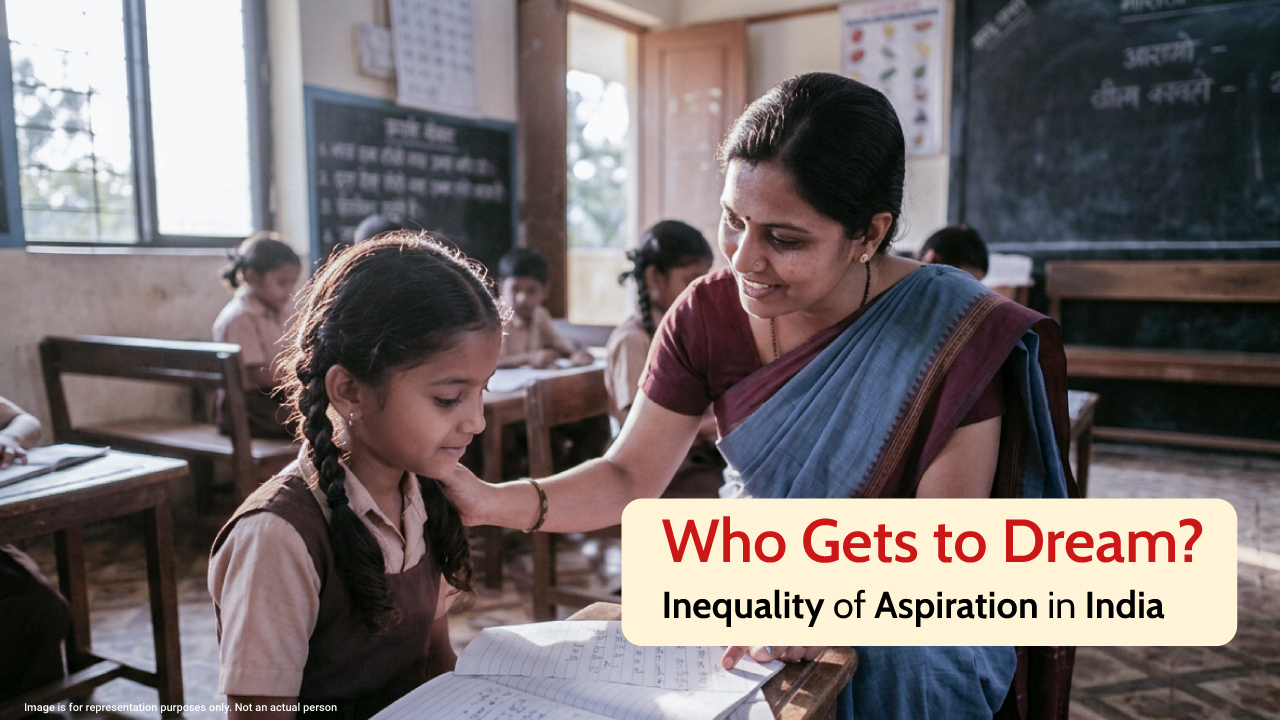
In a quiet classroom, a familiar question is asked. What do you want to become? Hands go up. Some answers come quickly. Doctor. Engineer. Entrepreneur. The words are confident, almost rehearsed. But in the same room, a few students hesitate. They look down, unsure. It is not that they lack ambition. It is that they have never been given the space to imagine it.
Aspiration is regarded as an individual quality. You either have it or you do not. However, in practice, exposure, condition, and chance determine aspiration. Dreaming ability is not uniform. It is unobtrusively shaped by the place of your birth, what you see around you, and what you are told you can.
The Uneven Starting Line
Not every child begins with the same horizon. For some, possibility is visible everywhere. They grow up surrounded by examples of success, access to information, and encouragement to aim high. Dreams are nurtured, discussed, and expanded.
For others, the horizon is narrower. Limited exposure, financial constraints, and social expectations begin to define what feels realistic. A child may never meet someone who works in a field they are curious about. They may not have access to guidance or resources that help them explore different paths.
Over time, this shapes not just opportunity, but imagination itself. When possibilities are not visible, they are harder to believe in. The question shifts from what I want to become to what is realistically allowed for someone like me.
When Potential Remains Unseen
Inequality of aspiration is not always obvious. It does not always appear as a lack of talent or effort. It often appears as self-doubt, hesitation, or the quiet acceptance of limited choices.
A student may perform well but choose a path that feels safer rather than one that excites them. Another may never pursue a skill simply because they do not see it as an option. In many cases, it is not ability that limits them, but belief.
This is where the gap becomes deeper. When potential is not recognized or encouraged, it begins to shrink. Over time, individuals adapt their dreams to fit their circumstances rather than expanding their circumstances to fit their dreams.
The loss here is not just personal. It is collective. When large sections of society are unable to fully imagine their potential, so are innovation, leadership, and creativity.
The Power of Exposure & Encouragement
Changing this reality does not begin with telling children to dream bigger. It begins by expanding their view.
Exposure has a potent influence. As youth are exposed to various role models, new ideas, and alternative career opportunities, their perception of what is feasible begins to change. One experience, one encounter, one tale can lead to previously unseen doors.
Motivation is also vital. When educators, families, and communities actively affirm a child's potential, it builds confidence. It conveys the idea that their dreams are not in vain and should be followed.
Safe spaces are important, too. The environment in which children are allowed to ask questions, teach what interests them, and speak out without fear forms the background for the aspiration to develop. Dreaming is not considered unrealistic in such spaces. It is perceived to be a necessity.
Rethinking Aspiration as a Collective Responsibility
Aspiration is not just an individual journey. It is shaped by systems and structures. Education, community networks, and social narratives all play a role in defining what people believe they can achieve.
When systems focus only on access without addressing confidence and exposure, the gap remains. A child may be in school, but still feel disconnected from the possibilities education is meant to unlock.
To truly address inequality of aspiration, the focus must shift from providing opportunities to also enabling belief. This means creating ecosystems where young people are not only taught skills, but are also encouraged to imagine futures that feel meaningful and attainable.
It also requires challenging deeply rooted assumptions about who gets to succeed. When society begins to value diverse journeys and redefine success, it creates space for more inclusive aspirations.
The Role of SivaShiksha
It is not enough to raise awareness in response to aspiration. It entails deliberate effort. SivaShiksha attempts to fill this invisible gap by providing a place where young people can see, explore, and believe in their potential.
Our programs are made to transcend traditional learning. This opens students' possibilities through creative expression, community engagement, and experiential workshops. These are not merely informative experiences. They are transformative.
Through collaboration with teachers and communities, SivaShiksha helps develop ecosystems that foster confidence and curiosity. We provide secure, welcoming environments where youngsters are motivated to inquire, envision, and dream.
Fundamentally, the change is in changing attitudes. As soon as children start to feel different about themselves, their decisions start to alter. And as more and more people broaden their dreams, the bigger story of who is allowed to dream in India begins to change.