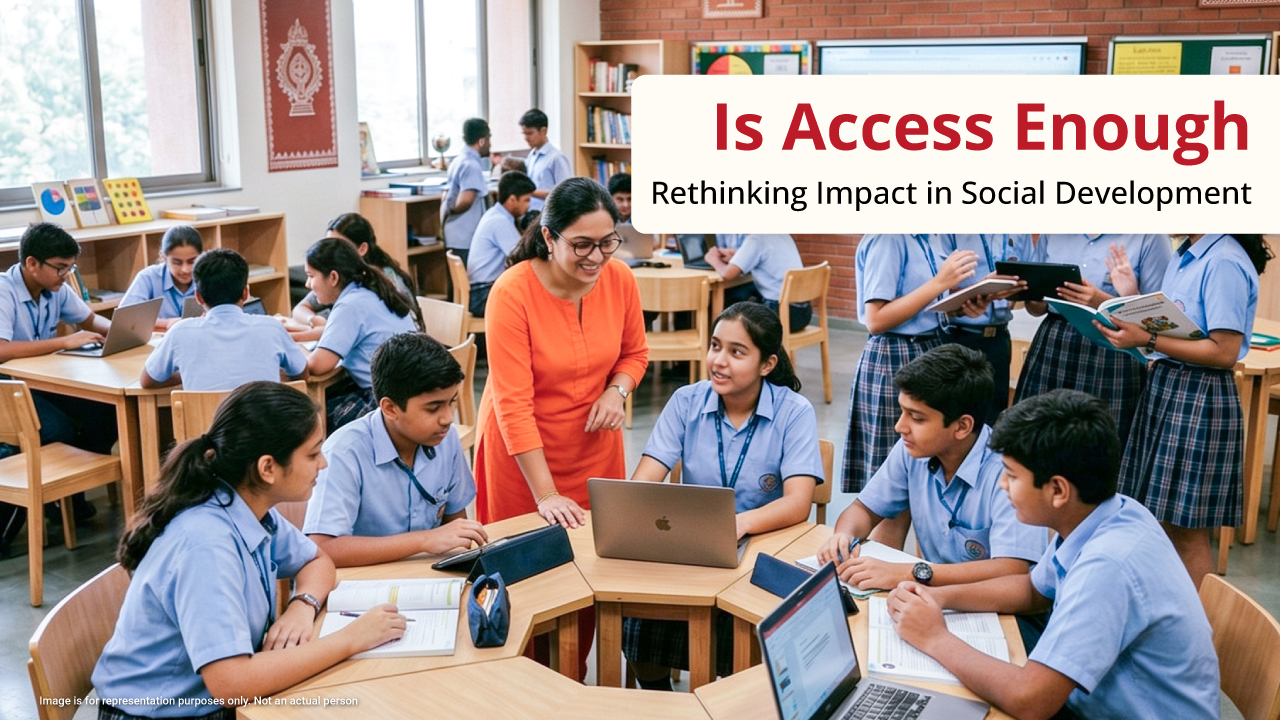
A new computer lab is inaugurated in a rural school. Tablets are distributed. Internet connectivity arrives for the first time. Photographs are taken, numbers are recorded, and the initiative is celebrated as progress. On paper, access has been created.
However, many devices go unused for months after that. Some students are reluctant to interact. Teacher support is inadequate, and teachers struggle. There are still a few children in the back of the room who aren't getting the opportunities they need.
This is the uncomfortable reality at the heart of social development. Access alone does not guarantee transformation.
For years, development conversations have focused on reaching people. Building schools, distributing resources, creating infrastructure, and expanding services. These efforts are essential. But somewhere along the way, an important question emerged. What happens after access is provided? Does opportunity automatically become empowerment?
The answer is far more complex.
The Gap Between Availability & Ability
Does there need to be a classroom, but does every child feel confident participating? Is there a scholarship available, but does the student think he belongs there? Digital tools may be offered, but is anyone available to teach how to use them effectively?
There is a difference between access and impact. In fact, it may be all about confidence, awareness, emotional support, and sustained engagement. Opportunities may be technically available but never realized if these are missing.
This difference is particularly stark in less-resourced communities where a legacy of exclusion, socialization, or economic disadvantage has a marked impact on people's relationship to opportunity. It may not always be just the distance; as a matter of fact, it is the hesitation that cannot be seen.
A young girl might be able to go to school, but be taught to have small ambitions. The first-generation learner can be in a class and yet quietly wonder, "What do I have to do here?" A community can be provided with resources, but may lack the leadership to ensure its sustainability.
Development cannot only ask whether systems exist. It must also ask whether people feel empowered to use them.
Why Human Experience Matters
Numbers can be used to measure social impact. Number of schools constructed. The number of people who were enrolled. The number of devices distributed. These indicators are important, but they don't necessarily capture the full picture of the human side.
Being there and making an impact are not just the consequences of participation. It's about change.
A first-time confident child speaker. Independent decision-making by a woman after financial competence. A young person who has begun to imagine a future they never thought possible. These changes don't always fit in easily with reports, but they are the underlying drivers of development.
In the absence of consideration of emotional wellbeing, self-belief, and community trust, even well-designed interventions may fail to achieve enduring change. People aren't going to grow just because resources are made available to them. Growth occurs when people feel noticed, supported, and capable.
Thus, social development must transcend transactional approaches to social support and embrace relational approaches to social empowerment.
Development That Listens, Not Just Delivers
Communities are typically viewed as recipients of solutions rather than contributors to their development. Programs are implemented rapidly, often without regard for local realities, with little understanding of local contexts and emotional obstacles.
However, making an impact is not always a one-way thing. It develops through listening, working together, and trust.
Community participation in decision-making improves the meaningfulness and flexibility of development. Solutions are based on experience, not assumptions. Individuals feel they own their change and do not rely on external systems.
This change also undercuts the notion that only large-scale impact counts. The most impactful shifts can occur more subtly. Safe study atmosphere. A support circle for women. A child finding confidence through creation. They can be small events, but they can result in long-term social change with a ripple effect over the years.
Reimagining What Progress Looks Like
A wider understanding of progress is needed for the future of social development. Infrastructure and access will always be significant, but they will also not be the ultimate aim.
The true test of impact is whether people can become fully involved in their own development. Whether they feel they have the power to make decisions, express themselves, and envision other lives.
This implies that development needs to encompass, in addition to traditional indicators, emotional wellbeing, community involvement, digital confidence, and inclusive curricula.
It also entails recognizing that empowerment isn't something that can be handed over. It needs to be cared for.
The Role of SivaShiksha
SivaShiksha takes a more human-centered view on social development and sees access as merely the starting point. Its efforts are directed at designing spaces and places that offer opportunities, but also develop the confidence and emotional support that will enable these opportunities to be sustained.
SivaShiksha strives to fill the invisible gaps left by other activities through experiential learning, community partnership, wellbeing initiatives, and inclusive education programs. It promotes involvement, self-expression, and local leadership, helping individuals become active agents of change rather than passive recipients.
Education and emotional awareness, imagination and community action: SivaShiksha is enabling the creation of environments where transformation is felt rather than hoped for. By doing this, it recasts the word 'impact' as access provided, but, more importantly, as human potential reawakened.