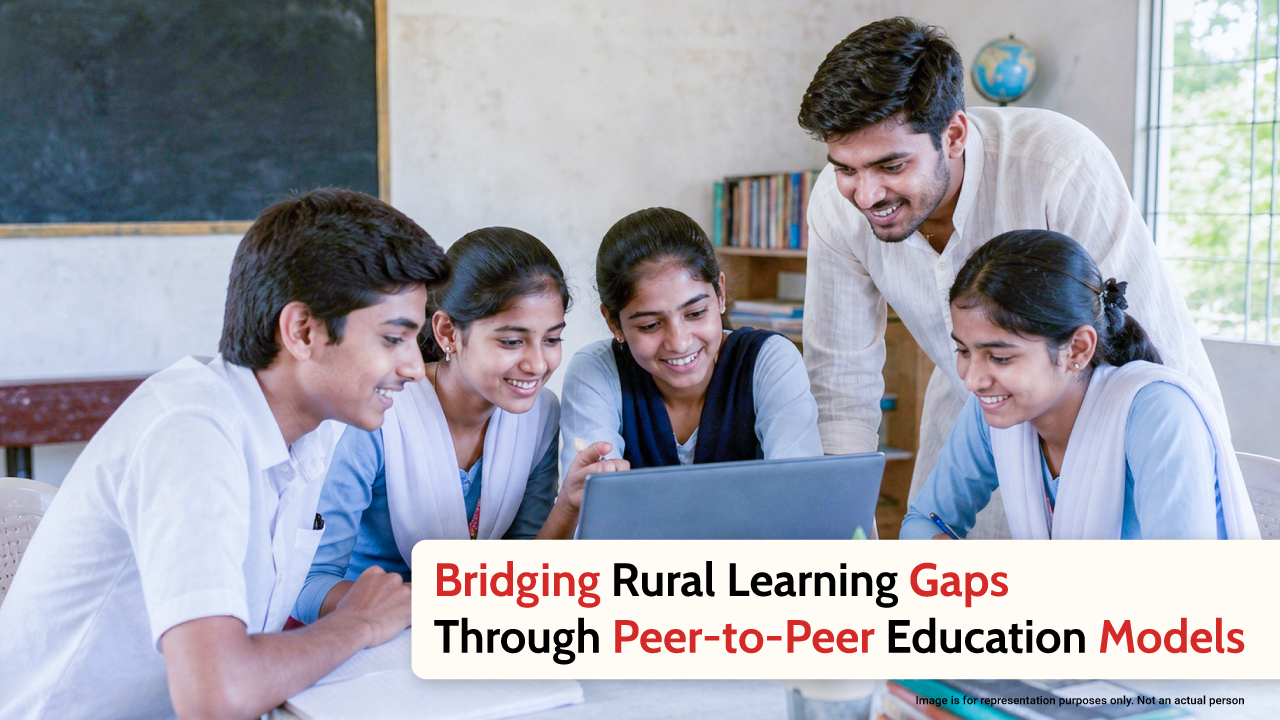
In many rural classrooms, learning does not stop when the teacher leaves. Long after the final bell rings, small groups of children continue to sit together under trees, in courtyards, or in community spaces. One child explains a math problem to another. Someone reads aloud while others listen carefully. Questions move freely between them. There is no pressure, no fear of getting answers wrong. There is just a shared effort to understand together.
These moments may seem simple, but they reveal something powerful. Learning does not always have to flow from the top down. Sometimes, the strongest learning happens between peers.
Across rural India, peer-to-peer education models are quietly emerging as meaningful ways to bridge learning gaps. In communities where access to resources, trained educators, or digital infrastructure may be limited, students themselves are becoming active participants in each other's growth.
When Learning Feels Distant
Rural schools are often beset by multiple difficulties simultaneously. Limited infrastructure, teacher shortages, the non-availability of learning materials, and socio-economic barriers can impact the continuity of education. Many children are first-generation learners and may be following a system that their families don't fully comprehend.
Education suffered long-term disruptions over the past few years, further exacerbating the learning gap. Pupils returned to class with varying levels of understanding, confidence, and engagement. Others had difficulty connecting with the lessons. Some walked quietly behind.
In these instances, the usual classroom arrangements may not be sufficient to address the needs and learning rates of all learners. Here comes the much-needed paradigm shift: peer-to-peer learning. It makes education a team sport and not a lonely one.
The Strength of Learning Together
Peer-to-peer education is built on a simple but effective idea. Students learn by supporting one another.
Children often explain concepts to peers in ways that feel relatable and easy to understand. There is less hesitation to ask questions and fewer fears about making mistakes. A child who may stay silent in front of a teacher might openly engage with a friend.
In this way, the learner's role is also altered. Students are not just passive recipients of information. They are part of their community, offering as contributors, mentors, and problem-solvers.
The impact goes beyond academics. Leadership skills start to develop spontaneously. Students' confidence increases as they discover that they can help people. Cooperation, rather than competition, becomes part of the learning culture.
The sight of someone who looks like them getting so far in life helps younger students develop a sense of possibility. It conveys a powerful message about the possibility of learning, a possibility shared.
Community as a Classroom
A powerful aspect of peer-led education is that it goes beyond school boundaries. Communities are learning environments.
Study circles, youth groups, and informal mentoring networks support continuity of learning in villages where formal learning support may be limited. Older students may help younger students read, improve language skills, or work through homework. Shared learning spaces create safe environments in some communities where curiosity is fostered.
In this collective model, social bonds are also reinforced. Children helping each other leads to increased family involvement in education. Learning is no longer just individual; it is becoming more community-based.
Most especially, peer learning respects local realities. It does not rely completely on costly infrastructure and formal systems. Instead, it is based on what is already good within the community.
More Than Academic Support
The value of peer education goes far beyond improving grades. It nurtures emotional and social development in ways that traditional systems sometimes overlook.
Children learn empathy when they help someone struggling to understand. They develop patience, communication, and responsibility. For many students, these experiences become the foundation of self-belief.
In environments where educational inequality can often lead to discouragement, peer support creates a sense of belonging. Students begin to feel that they are not facing challenges alone.
This emotional connection is especially important in rural settings where access to counseling or wellbeing support may be limited. A supportive peer network can become a lasting source of motivation and resilience.
The Role of SivaShiksha
Sustainable learning ecosystems need to be community and people-centered. SivaShiksha values student collaboration in learning and seeks to build grassroots learning models through inclusion-based learning activities.
Our programs promote experiential learning, youth leadership, and peer engagement as key components of education. SivaShiksha facilitates student engagement in the growth and transformation of one another, helping to shift the paradigm from teaching to empowerment.
Workshops, creative activities, and community-based interventions are designed to develop confidence, community-centeredness, and academic knowledge. Young learners are encouraged not only to take in knowledge but to become facilitators of change in their own environment.
SivaShiksha is part of an education model that is accessible, participative, and human. By providing resources and building relationships, trust, and growth together, we work to meaningfully address rural learning gaps.