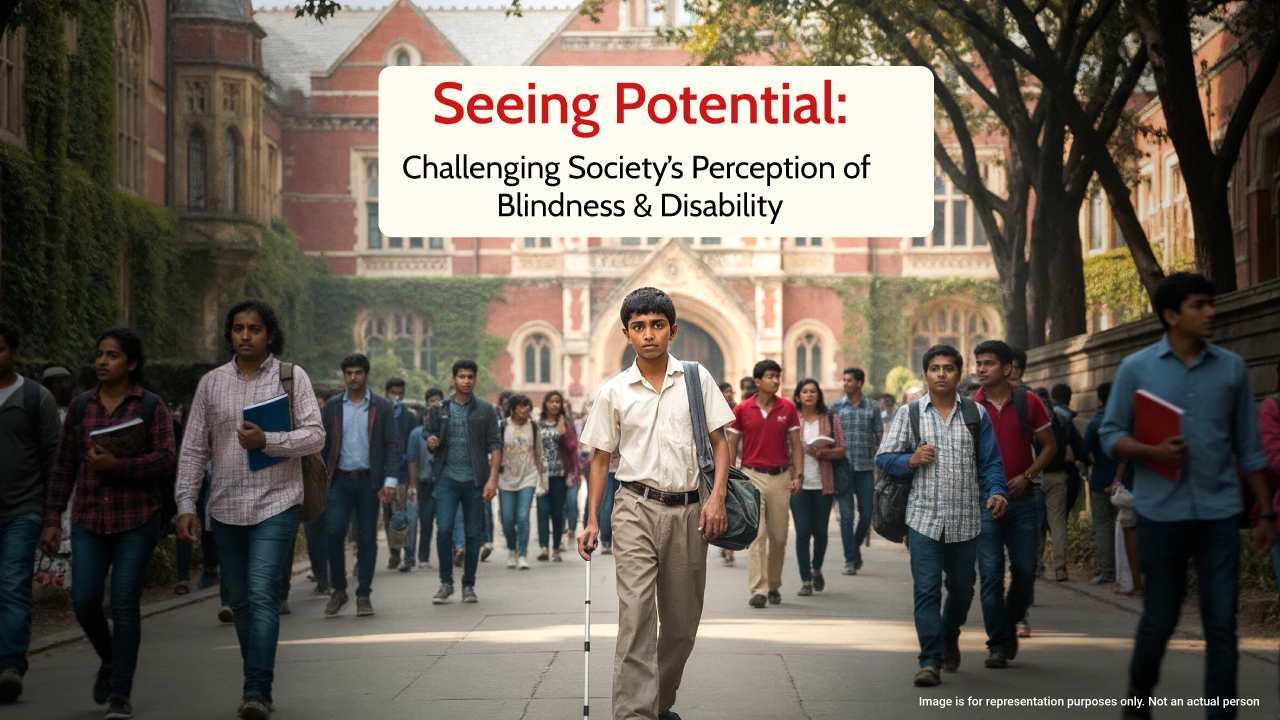
When a white cane-carrying person enters a room, that room becomes silent. The conversations become sluggish, interest turns to uncertainty, and at other times, a kind of sympathy replaces regular communication. In that case, an assumption has been made even before a word has been said.
Blindness makes it easy to see blindness before one sees the person, because of society.
Since their childhood, most individuals are socialized, either explicitly or implicitly, that disability is a sign of weakness. The plots of blindness are put in perspective of suffering, reliance, or loss. Consequently, when a visually impaired person enters a classroom, workplace, or community place of interest, the response is usually influenced not by the truth but by perception.
Blindness, however, is not an incapacity. It is just another experience of the world.
Experiencing the World Without Sight
A visually impaired person perceives the world through sound, touch, memory, and space. Footsteps in a passage, the change in air with the opening of a door, the slight variations of surfaces on the bottom of the feet, all these things make a landscape, which few sighted people pay attention to. The point of navigation is attained through conscious concentration, not as an eye point.
However, as people change with such great dexterity, society does not always change with them.
The most significant obstacle that blind people struggle with is not blindness, but assumptions. Opportunities are lost in silence when expectations are lowered. It is possible that a teacher may assume a student with visual impairment will not cope with complex topics. There is a possibility that an employer will be reluctant to employ an individual who uses assistive technology. Even in daily interactions, there might be an unconscious rule that one cannot be independent.
Ignorance & the Roots of Misconception
Cruelty almost never brings these perceptions. In most cases, they develop out of ignorance.
Blindness is a concept that many people have never encountered regularly. In the absence of exposure, knowledge is difficult to acquire. Consequently, interactions are normally governed by caution or sympathy rather than equality.
But the truth is quite the opposite of these suppositions.
In society, the blind engage in learning, establish careers, continue and nurture families, and make contributions. Assistive technologies have opened new horizons in communication, learning, and professional work. There are screen readers to enable access to digital content, voice-enabled devices to help with navigation and productivity, and adaptive technologies to support people across various professions.
It is not something extraordinary that alters lives; it is rather the elimination of unnecessary barriers.
Creating Accessible Environments for All
Visually impaired students have a full part in academic life when learning materials are readily available in their classrooms. The talent can play their roles when workplaces embrace inclusive technologies and other flexible practices. Accessibility of public space makes mobility not a challenge but a freedom.
Yet it is not infrastructure or technology that creates inclusion. It is also constructed by attitude.
Societal discourses on disability define how individuals with disabilities identify themselves. By providing narratives in which struggling is the sole element, people inadvertently reinforce the notion that being blind is what makes a person who they are. As narratives emphasize resilience, creativity, and capability, they broaden communities' understanding of human potential.
The issue of representation is critical in this transformation.
The collective imagination is redefined by visually impaired people becoming educators, artists, leaders, and workers. It also tells society that ability is not assessed by sight, but rather by opportunity and support. Every apparent instance breaks the silent assumptions that previously curtailed expectations.
The role of everyday interactions is also equally important. A dialogue about blindness that refers to a person as an equal partner and not one who is receiving assistance. A lesson in which students are motivated to be inquisitive rather than uncomfortable. An organizational culture based on ability and not perceived disability.
These minor changes gradually alter social perception.
Fostering Positive Social Change
In a sense, the difficulty of confronting the societal perception of blindness begins with this simple question: What would happen if we no longer focused on what we have lost, but rather on what we could do?
The solution lies in making the spaces where nobody is defined by their disability, but by their strengths, ambitions, and contributions. It is found in communities that treat accessibility as charity rather than as an essential part of justice.
This change demands consciousness, sympathy, and cooperation.
Grassroots organizations are significant in forming these dialogues. They can connect communities with resources, spark conversations about inclusion, and make education more approachable, so people stop seeing it as a limitation and start seeing it as a possibility.
SivaShiksha: Empowering Inclusive Communities
SivaShiksha aims to build communities where people with disabilities are perceived not as a limitation, but as a promise. The organization promotes discussions that break the stereotypes about blindness and disability through awareness campaigns, education, and community involvement. Its initiatives focus on the value of inclusive settings where accessibility, dignity, and equal opportunity are accorded the highest priority.
SivaShiksha will help reform the societal attitude towards disability by creating awareness and reinforcing a culture of communities supporting the disabled. Opportunities come along with a change of perception. And as chances increase, those previously considered secondary are at last given a chance to come forward, not as exceptions, but as players in a world that has come to appreciate their abilities.