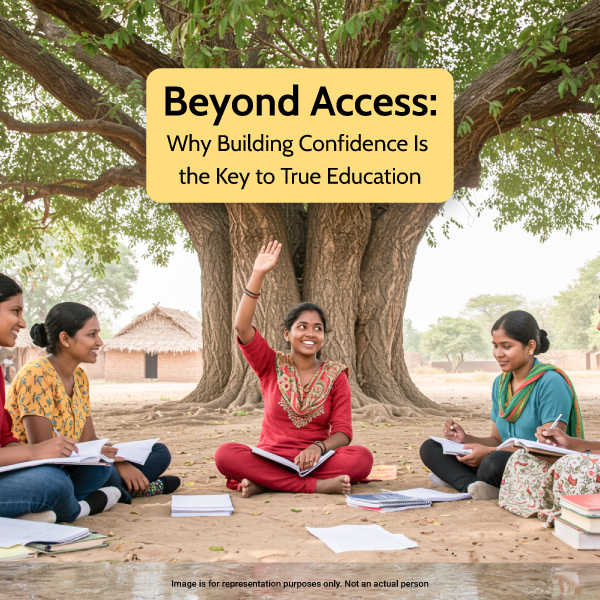
Ishita always sat in the second row of her classroom, close enough to hear clearly yet far enough to remain unnoticed. Although she often knew the answers before anyone else, her hand stayed down. She learned, gradually and subtly, that attention could come at a price: a wrong answer might spark laughter, while a right one might invite questions she was not ready to answer. Over time, silence became her safest choice.
Stories like Ishita’s echo through schools and community halls across the country. While we often focus on access to education, resources, or opportunity, we rarely talk about confidence, the invisible skill that decides whether any opportunity is ever truly seized. Confidence is not a fixed trait, nor is it simply a matter of personality. Instead, it is shaped by the environment: how questions are welcomed, mistakes are received, and learners are encouraged to participate.
Low confidence rarely looks dramatic; it hides in hesitation, self-doubt, and playing it safe. It appears when a student knows the answer but remains quiet, when a girl avoids leadership roles despite her talent, or when someone avoids new subjects, believing they are not meant for them. Over time, this internal barrier becomes a habit that quietly limits potential and reinforces inequality, not by blocking access but by eroding belief.
This is where SivaShiksha steps in. SivaShiksha recognizes that confidence is not a byproduct of education but a competency to be cultivated with care. By creating emotionally safe, inclusive learning spaces and encouraging expression and dialogue, SivaShiksha helps learners find their voice. Students who once hesitated begin to participate; those who doubted themselves try new things. SivaShiksha’s approach empowers individuals not just by teaching but by truly seeing and hearing them, so confidence becomes a lasting foundation for growth.
Learn More: Confidence as a skill: building empowerment and self-belief